Best eBikes for Canadian Fall Riding: What to Look for Before You Buy
Share
Fall is one of the best seasons to ride an eBike in Canada—but it is also when the right bike setup starts to matter more.
A September commute in Montréal is different from a weekend ride on gravel outside Calgary. A daily ride through Toronto streets has different requirements from exploring trails around Vancouver or Québec's Eastern Townships.
As temperatures drop, you may encounter wet pavement, fallen leaves, shorter daylight hours, cooler batteries, and rougher road conditions. That does not mean you need to put your eBike away. It means you should choose a bike that matches how and where you actually ride.
If you're shopping for an eBike in Canada this fall, here are the five things worth paying attention to before you buy—and several models currently available through EZWheel Canada.
1. Start With Where You Ride, Not How Much Power You Want
One of the easiest mistakes when buying an eBike is starting with motor wattage.
A better question is:
Where will I ride this bike most of the time?
Your answer can quickly narrow down the type of eBike you need.
Mostly city streets and bike paths?
Look for a commuter or hybrid eBike with practical features such as:
- Fenders
- Integrated front and rear lights
- A rear rack
- Comfortable geometry
- Suspension for rough pavement
- Reliable hydraulic or mechanical disc brakes
Mixed pavement, gravel and trails?
A fat-tire eBike can make more sense if your regular routes include gravel roads, packed paths, parks, or rougher surfaces.
Longer daily commutes?
Battery capacity becomes much more important. A larger battery can give you more flexibility between charges, although real-world range will vary with rider weight, temperature, terrain, assist level, wind, tire pressure, and other conditions.
The right eBike is not necessarily the most powerful one. It is the one that fits your normal riding conditions.
2. Pay Attention to Tires and Traction
Canadian fall riding can be unpredictable.
One part of your route may be dry pavement while another has wet leaves, gravel, or broken pavement. This is where tire choice becomes especially important.
Are fat tires better for fall riding?
Not necessarily for everyone—but they can be useful for riders who regularly encounter uneven or mixed surfaces.
A 4-inch-wide tire provides a larger contact area and can make an eBike feel more planted on loose or rough surfaces. It can also provide additional cushioning compared with narrower commuter tires.
For example, the EZWheel Electric Fat Bike X1 & X2 uses 20" × 4" fat tires, a 48V 500W brushless hub motor, hydraulic disc brakes, and five levels of pedal assist. The X1 uses one 48V 13Ah battery, while the X2 configuration uses two batteries.
The X1/X2 can be a practical option if your fall riding includes a mix of:
- City streets
- Gravel paths
- Parks
- Rough pavement
- Recreational rides
The key point is that fat tires are about versatility and stability—not a guarantee of traction on ice or snow.
No tire makes black ice safe.
3. Battery Size Matters More Than Maximum Range Claims
When Canadians compare eBikes, range is often one of the first specifications they see.
But don't simply choose the bike with the biggest number.
Instead, think about your actual weekly riding.
If your commute is 10–15 km each way, your needs will be very different from someone planning 60–80 km weekend rides.
And there is another factor Canadian riders need to consider:
Cold temperatures can affect battery performance.
Lithium-ion batteries generally deliver less usable performance in colder temperatures. This means the range you experience on a cool November morning may not be the same as the manufacturer's maximum range under ideal conditions.
For that reason, we recommend choosing some extra battery capacity if you regularly ride longer distances.
A good example: Heybike Hybrid
The Heybike Hybrid is built for riders who want a bike that can handle commuting, errands, and longer recreational rides.
It uses an 864Wh battery and has a claimed maximum range of up to 100 miles under ideal conditions. It also features a 750W motor, 27.5" × 2.4" tires, a 440 lb maximum load, front and rear lighting, and Tektro hydraulic brakes.
The important takeaway isn't the “100-mile” number.
It is the combination of battery capacity + practical equipment + cargo capacity + commuter-oriented design.
That's what makes a difference when you're using an eBike as transportation rather than simply taking a short recreational ride.
4. For Canadian Commuters, Fenders and Lights Are Not Just Extras
If you're buying an eBike for commuting, look beyond the motor and battery.
Ask yourself:
What happens when I ride to work on a wet October morning?
That's where equipment such as fenders, lights, racks and suspension becomes valuable.
Aventon Level 3: Built Around Daily Commuting
The Aventon Level 3 is currently listed at EZWheel Canada with a rear rack, fenders, front suspension and a suspension seat post. It also features Aventon's ACU technology with GPS tracking, auto-lock, unusual movement detection and an alarm system.
For a commuter, these features solve real problems:
Fenders:
Help reduce water and road spray reaching your clothes.
Rear rack:
Useful for carrying a backpack, groceries or work equipment.
Front suspension:
Can make cracked pavement, potholes and uneven bike paths more comfortable.
Integrated lighting:
Important as daylight hours get shorter in fall.
Security technology:
Useful if you regularly leave your eBike outside a workplace, café, apartment, or transit station.
This is a good example of why the “best eBike” depends on how you plan to use it.
5. Consider Your Terrain Before Choosing a Fat-Tire eBike
Fat tires are useful—but they're not automatically the best choice for every Canadian rider.
A 20" × 4" fat-tire eBike can be heavier and may feel different from a narrower commuter bike. If 90% of your riding is on smooth city pavement, you may prefer a more traditional commuter setup.
But if you regularly switch between pavement, gravel and trails, a fat-tire eBike can give you more flexibility.
EZWheel S3 Fat Bike
The EZWheel S3 Fat Bike is designed around that type of mixed-terrain use.
It features:
- 500W BAFANG hub motor
- 48V 20Ah lithium battery
- 20" × 4" Kenda fat tires
- Front suspension
- Shimano 7-speed derailleur
- Front and rear hydraulic disc brakes
- Throttle and five levels of pedal assist
- Integrated LED headlight
The 48V 20Ah battery is one of the S3's standout specifications, especially for riders who want more battery capacity for longer recreational rides.
Again, the goal isn't simply to buy the bike with the biggest specifications.
It's to match those specifications with your route.
6. Don't Buy an eBike Based on Range Alone
Here's a simple example.
Two bikes might both advertise a long maximum range, but the actual distance you get can vary significantly depending on:
- Rider weight
- Cargo
- Hills
- Wind
- Temperature
- Tire pressure
- Riding speed
- Pedal-assist level
- Stop-and-go traffic
- Surface conditions
This is especially relevant in Canada.
A ride in Montréal during a cool, windy October morning can produce very different battery consumption from a flat summer ride under ideal conditions.
A better way to estimate your needs
Think about your normal round-trip distance, then leave yourself a reasonable buffer.
For example:
15 km each way × 2 = 30 km daily
If that's your typical commute, you don't want to shop for a bike that only barely covers 30 km under ideal conditions.
You want enough capacity for weather, hills, detours, battery ageing and the occasional longer ride.
7. What About the Aventon Aventure 3?
For riders looking specifically for a fat-tire adventure eBike, the Aventon Aventure 3 is another model worth knowing about.
It combines:
- 4" fat tires
- Suspension fork
- Suspension seat post
- 750W motor
- Claimed range of up to 65 miles
- Aventon ACU technology
- GPS/4G connectivity
- Anti-theft features
This combination makes it particularly relevant for riders who want a more adventure-focused eBike rather than a traditional city commuter.
However, availability matters: the Aventure 3 is currently listed as out of stock on EZWheel Canada's product page.
If you're interested in this model, check the product page for current availability rather than assuming it is ready to ship.
Which eBike Makes Sense for You?
Instead of ranking these bikes from “best” to “worst,” here's a more useful way to compare them.
| If you mainly want to... | Consider | Key features |
|---|---|---|
| Ride around the city and on mixed surfaces | EZWheel X1 & X2 | 20" × 4" tires, 500W motor, hydraulic brakes, 1- or 2-battery options |
| Ride farther and carry more | Heybike Hybrid | 864Wh battery, up to 100-mile claimed range, 440 lb max load |
| Commute every day | Aventon Level 3 | Rack, fenders, suspension, integrated security technology |
| Ride gravel and rougher terrain | EZWheel S3 | 20" × 4" Kenda tires, 48V 20Ah battery, suspension |
| Go further off pavement | Aventon Aventure 3 | 4" fat tires, suspension, 750W motor, 65-mile claimed range |
Specifications are manufacturer-listed figures and real-world performance will vary.
What Should You Budget for an eBike in Canada?
Price is obviously part of the decision.
But don't compare bikes on sticker price alone.
Look at the complete package:
Bike + battery + included equipment + warranty + service + shipping + replacement parts + local support
For example, EZWheel currently lists the EZWheel X1/X2 at C$1,499, the S3 at C$1,799, the Heybike Hybrid at C$2,399, and the Aventon Level 3 at C$2,399. Prices and promotions can change, so check the product page for the latest price before purchasing.
For Canadian shoppers, this total ownership picture is often more useful than simply searching for the cheapest eBike online.
Why Local Support Matters When Buying an eBike in Canada
An eBike is not a one-time-use product.
You will eventually need to think about maintenance, tires, brakes, adjustments, replacement parts and warranty support.
That's why local support can matter when comparing retailers.
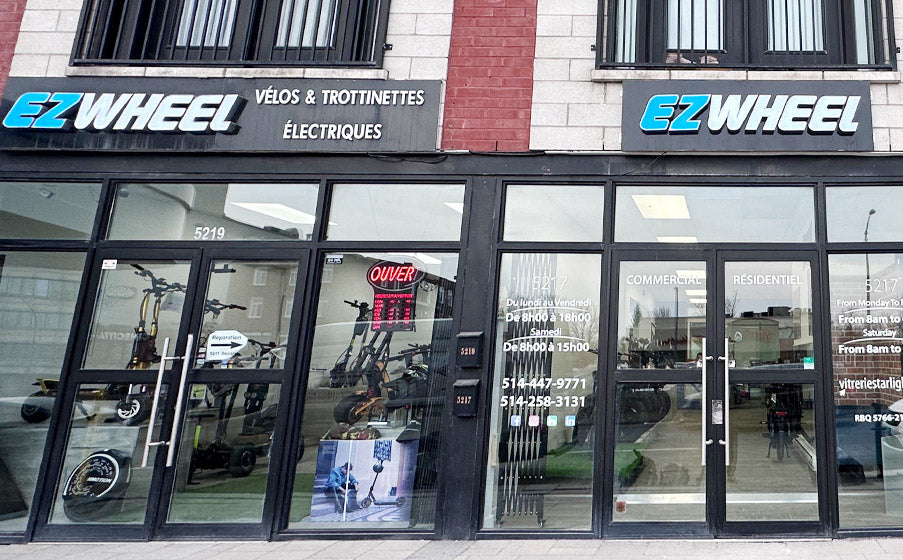
EZWheel has a Montreal headquarters and showroom where customers can get support and take test rides. The company also states that customers have access to more than 20 certified service centres across Canada and the USA. EZWheel offers a one-year warranty on the models referenced above, along with a Lifetime Service Program providing 20% off parts and labour after the warranty period.
For Canadian customers, EZWheel also offers parcel shipping across Canada on bikes and scooters, with delivery times varying by location. Its site currently states that in-stock models generally ship within 24–48 hours, while delivery to Western Canada can take approximately 3–7 business days.
These details are worth checking before you buy—especially if you need your eBike for work or daily transportation.
A Simple Fall eBike Buying Checklist
Before you click Buy, ask yourself these questions:
Your riding
- How many kilometres will I ride on a normal day?
- Will I mainly ride pavement, gravel, trails, or a combination?
- Do I need to carry groceries, work equipment, or other cargo?
The bike
Does it have tires appropriate for my usual terrain?
- Is the battery large enough for my typical ride with some reserve?
- Does it have reliable disc brakes?
- Do I need front suspension?
- Does it include fenders?
- Does it have integrated lights?
- Is the frame size appropriate for my height?
Ownership
- Where will I get warranty service?
- Can I get replacement parts?
- Is there a local showroom or service option?
- What does shipping cost?
- What is actually covered by the warranty?
If you can answer these questions before buying, you'll have a much better idea of what type of eBike actually fits your needs.
Don't Wait Until Winter to Choose Your Fall Ride
Canadian fall doesn't mean the end of eBike season.
For many riders, September and October can be some of the most enjoyable months of the year to ride—before snow and ice become a regular part of the forecast.
The key is choosing equipment that matches the way you ride.
If you commute every day, prioritize fenders, lights, comfort, battery capacity and practical cargo space.
If you ride a mix of pavement and gravel, look more closely at tire width, suspension and braking performance.
If you're planning longer weekend rides, pay more attention to battery capacity, riding position and cargo capacity.
And if you want one bike that can handle a wider range of surfaces, a fat-tire eBike may be worth considering.
Ready for Your Fall Ride?
EZWheel Canada's current Fall promotion offers up to $300 in savings on select eBikes, including models such as the EZWheel X1/X2 and Aventon Level 3. Availability and promotions can change, so check the product page for current pricing and stock.
Explore EZWheel Canada's eBike collection and find a ride that fits your commute, weekend plans, and Canadian fall conditions.
Ride more. Explore more. Make the most of fall.
Recent Blogs

Best eBikes for Canadian Fall Riding: What to L...
Fall is one of the best seasons to ride an eBike in Canada—but it is also when the right bike setup starts to matter...

How to Ride an Electric Bike in Fall: 9 Tips fo...
Cooler temperatures, shorter days, and wet roads don't have to stop your e-bike season. Discover 9 practical tips for safe, comfortable fall riding in...

Quebec Electric Bike Laws: E-Bike Rules, Speed ...
Electric Bike Laws in Quebec: What Riders Need to Know Thinking about buying an electric bike in Quebec? Whether you're commuting through Montréal,...